Introducing Prism
Accelerating science writing and collaboration with AI.
Science shapes nearly every part of daily life—from the medicines we rely on, to the energy that powers our homes, to the systems that keep us safe. But the pace of scientific progress is still constrained by how research is done day to day. While AI has advanced rapidly, much of the everyday work of science still relies on tools that haven’t fundamentally changed in decades.
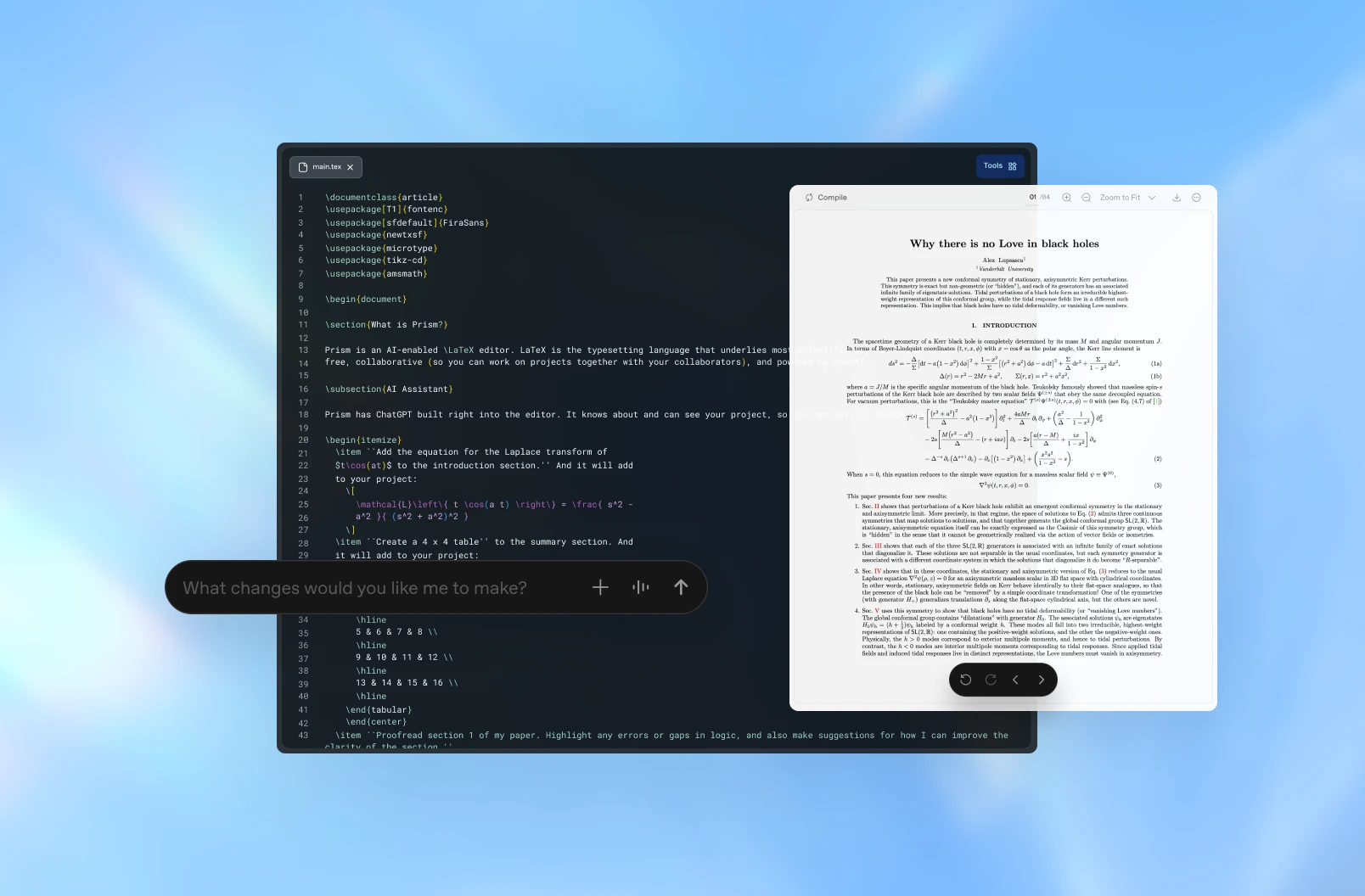
We’re introducing Prism, a free, AI-native workspace for scientists to write and collaborate on research, powered by GPT‑5.2. Prism offers unlimited projects and collaborators and is available today to anyone with a ChatGPT personal account.
Prism will be available soon to organizations using ChatGPT Business, Enterprise, and Education plans.
Over the past year, we’ve begun to see AI accelerate scientific work across domains. Advanced reasoning systems like GPT‑5 are helping push the frontiers of mathematics, accelerating the analysis of human immune-cell experiments, and speeding up experimental iteration in molecular biology.
We’re still early, but it’s clear that AI will play a meaningful role in how science advances.
At the same time, much of the everyday work of research—drafting papers, revising arguments, managing equations and citations, and coordinating with collaborators —remains fragmented across disconnected tools. Researchers often move between editors, PDFs, LaTeX compilers, reference managers, and separate chat interfaces, losing context and interrupting focus.
Prism is our first step toward addressing this fragmentation.
Prism is a free workspace for scientific writing and collaboration, with GPT‑5.2—our most advanced model for mathematical and scientific reasoning—integrated directly into the workflow.
It brings drafting, revision, collaboration, and preparation for publication into a single, cloud-based, LaTeX-native workspace. Rather than operating as a separate tool alongside the writing process, GPT‑5.2 works within the project itself—with access to the structure of the paper, equations, references, and surrounding context.
Prism builds on the foundation of Crixet, a cloud-based LaTeX platform that OpenAI acquired and has since evolved into Prism as a unified product. This allowed us to start with a strong base of a mature writing and collaboration environment, and integrate AI in a way that fits naturally into scientific workflows.
With Prism, researchers can:
- Chat with GPT‑5.2 Thinking, to explore ideas, test hypotheses, and reason through complex scientific problems in context
- Draft and revise papers with the full document as context, including surrounding text, equations, citations, figures, and overall structure
- Search for and incorporate relevant literature (for example, from arXiv) in the context of the current manuscript, and revise text in light of newly identified related work
- Create, refactor, and reason over equations, citations, and figures, with AI that understands how those elements relate across the paper
- Turn whiteboard equations or diagrams directly into LaTeX, saving hours of time manipulating graphics pixel-by-pixel
- Collaborate with co-authors, students, and advisors in real time, with edits, comments, and revisions reflected immediately
- Make direct, in-place changes to the document when requested, without copying content between separate editors or chat tools
- Use optional voice-based editing to make simple changes without interrupting writing or review
Scientific research is inherently collaborative. Papers are shaped over time by co-authors, students, advisors, and reviewers, often across institutions and geographies.
Prism supports unlimited collaborators, allowing research teams to work together without seat limits or access barriers. Because it’s cloud-based, there’s no local LaTeX installation or environment management required, making it easier for teams to collaborate in a shared workspace.
By reducing version conflicts, manual merging, and mechanical overhead, Prism helps teams spend less time managing files and more time engaging with the substance of their work.
Just as importantly, Prism is designed to expand access.
Prism is free to use, and anyone with a ChatGPT account can start writing immediately. There are no subscriptions or seat limits. By making high-quality scientific tools easier to adopt and broadly available, we hope to enable more researchers—across institutions, disciplines, and career stages—to participate fully in the scientific process.
More powerful AI features will be made available through paid ChatGPT plans over time.
In 2025, AI changed software development forever. In 2026, we expect a comparable shift in science, as AI begins to meaningfully accelerate discovery in several ways, one of which is reducing friction in day-to-day research work. Prism is an early step toward that future.
We’re excited to learn from researchers using Prism today and to continue building toward tools that help science move faster—together. Try Prism for free today at prism.openai.com(opens in a new window).