A practical guide to building with GPT‑5
Proven startup strategies to migrate, prompt, and scale with OpenAI’s newest frontier model.
Built for the full spectrum of coding and agentic tasks, GPT‑5 is faster, smarter, and more adaptable than anything we’ve released before. Its greatest strength is how responsive it is to your direction, making it easier than ever to shape behavior for your specific use case.
But here’s the catch: every new model ‘thinks’ a little differently. Prompts that worked with GPT‑4.1 or other models won’t always translate directly. To unlock GPT‑5’s full potential, you’ll need to refine your prompts and tailor them to its unique behaviors and personality.
Our newest flagship model represents a major leap forward in what startups can accomplish, both due to its state-of-the-art performance (74.9% on SWE-bench Verified) and the controls developers have to steer and shape behavior. GPT‑5 excels at agentic and multi-step reasoning tasks where reliability, depth, and control matter: parsing complex inputs, orchestrating tool use, or managing multi-stage workflows. Beyond agentic use cases, whether you’re refining natural language interfaces, powering developer tools, generating structured outputs, or automating complex business processes, GPT‑5 delivers higher accuracy, better consistency, and more predictable behavior than any previous model.
In this guide, we’ll share proven techniques to get the most out of GPT‑5 based on our work with leading startups with technical resources and actionable steps to get started.
Migrate: Steps to migrate to the Responses API, designed for long-term scale, speed, and new reasoning capabilities.
Optimize: Techniques to develop strong prompting that help you move faster and reduce engineering overhead.
Steer: New controls let you guide how the model reasons and communicates to match effort and output based on task complexity.
Troubleshoot: Resources to avoid common pitfalls like overthinking or overly verbose answers.
By the end of this guide, you should understand how to leverage GPT‑5 to its full potential to unlock more consistent, predictable, and accurate behavior while optimizing costs.
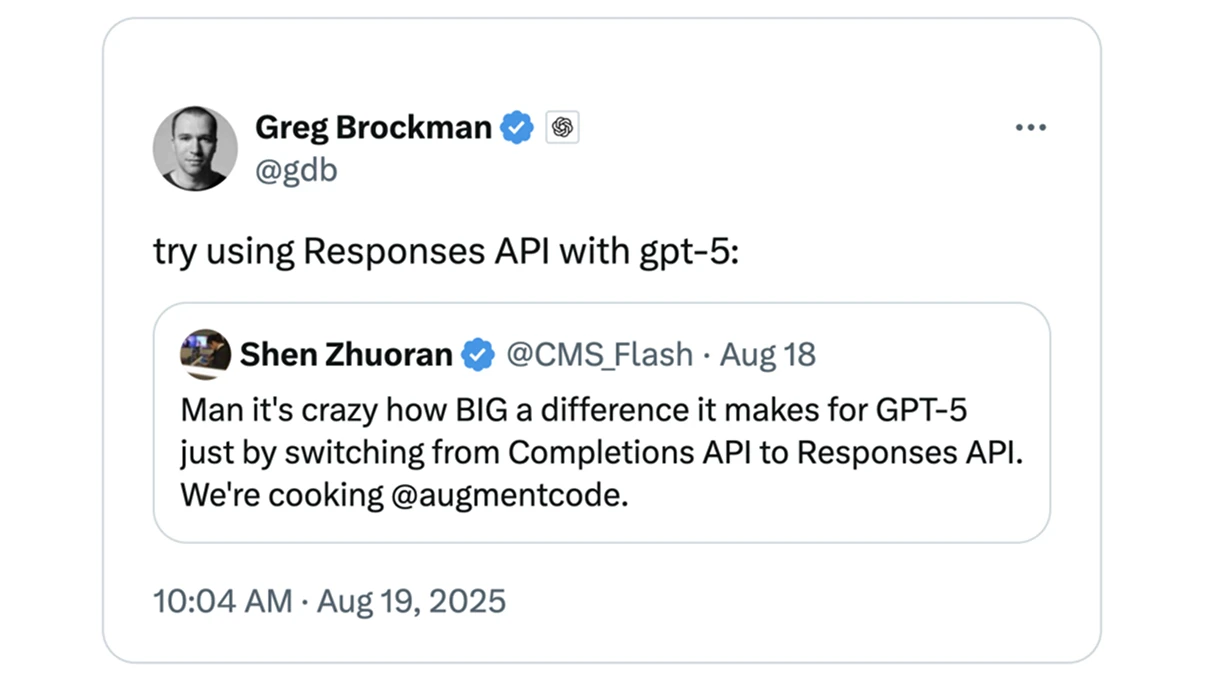
Your first step to unlocking GPT‑5’s full intelligence is to build on the infrastructure designed for it. Only the Responses API allows the model to persist its chains of thought (reasoning items) across turns and tool calls, either with OpenAI managing state or by passing back encrypted reasoning items.
This means every request to the model has access to its complete internal context, significantly boosting performance and improving caching to lower costs—capabilities the Chat Completions API simply doesn’t support.
Smarter tool use and built-in state management reduce glue code and orchestration. You ship faster with fewer engineers and focus more time on your product and customers.
Full-context reasoning plus faster performance and higher cache-hit rates lower infrastructure costs and latency as you grow. With zero-data retention (ZDR) compatibility, you’re not locked into today’s deployment pattern—you’re ready for the agentic workflows that will define tomorrow’s applications.
The Responses API is the path forward for new reasoning capabilities. Building here keeps you off legacy APIs when the most powerful features ship and aligns your codebase with where OpenAI is investing most heavily, giving you long-term stability as the ecosystem evolves.
The Responses API is the unified surface for working with GPT‑5. To maximize performance and future-proof your startup, we highly recommend moving workflows to the Responses API today.
Getting started with Responses API
Moving to GPT‑5 isn’t just about adopting a new model – it’s about mastering how to optimize it. Startups that develop strong prompting practices move faster, spend less on engineering overhead, and create products that feel meaningfully better to users.
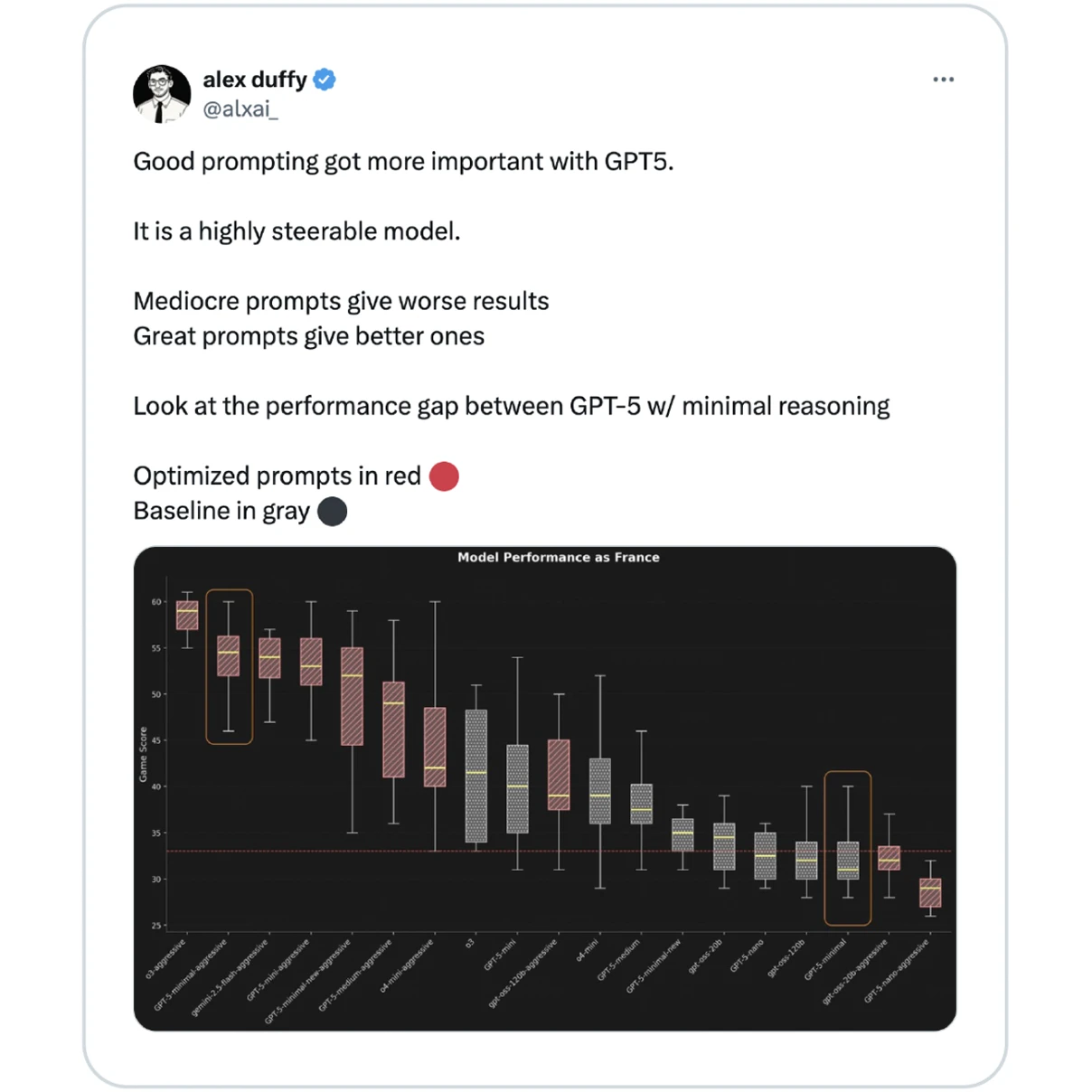
Begin by running your existing prompts as is against your evals to establish a baseline and see where outputs diverge from expectations.
For specific failure cases, loop the eval again and stream reasoning summaries with GPT‑5 in the Responses API. Watching the model reason helps you pinpoint where it needs more steering.
GPT‑5 is skilled at metaprompting—use the model to improve its own prompts as you iterate. Often, it requires less scaffolding than older models; shorter, clearer instructions can perform better.
When prompts work reliably, lock them into reusable templates or a prompt library. Document what good vs. bad outputs look like so the team can build consistently, and revisit periodically as techniques evolve.
GPT‑5 introduces new controls that let you fine-tune how the model reasons and communicates. These capabilities help startups match model effort and output to the unique complexity of their products.
reasoning_effort controls how much the model thinks (and how readily it calls tools). The default is medium; options are minimal, low, medium, and high. Experiment to right-size effort to the complexity of your task and measure against your evals using the prompting guide(opens in a new window).
verbosity influences the length of the model’s output. Options are low, medium, and high. You can also add prompt instructions for scenarios where you want the model to override the default.
GPT‑5 is highly steerable. These parameters give you more control over model behavior. There’s no single deterministic best configuration - systematically experiment and evaluate to identify what works best for your use case.
New & enhanced capabilities
From working closely with hundreds of startups, we see recurring issues such as overthinking, underthinking, over-deference, overly verbose outputs, latency problems (see Latency Optimization(opens in a new window)), tool overuse, and malformed tool calls. Because GPT‑5 is highly steerable and eager to follow instructions, careful prompt tuning—paired with solid evals and metaprompting—resolves most of these quickly. For deeper guidance on diagnosing and correcting each pattern, explore the GPT‑5 Troubleshooting Cookbook(opens in a new window).
This guide was developed by Hillary Bush(opens in a new window), Startups Account Director, and Prashant Mital(opens in a new window), Startup Solutions Architect, based on their experience working with top startups leveraging GPT‑5.
They created this guide after helping dozens of early-stage and growth-stage startups adopt GPT‑5 in production, seeing consistent patterns in how the most successful teams migrated APIs, tuned prompts, and used new reasoning controls to ship faster and build stronger products.
The goal of the OpenAI Startups Team is to share these best practices broadly so any startup, whether pre-seed or scaling globally, can accelerate its journey from idea to impact with GPT‑5. We hope you found this guide useful – happy building!